
F1 COMPRESSION RATIO CONTROVERSY
In our recent email newsletter we looked at the latest controversy to grip Formula 1, which is the subject of compression ratio. We were deluged with enquiries from people who had missed out on this newsletter, so we decided to republish it here. (If you haven’t already subscribed to our weekly email newsletter then you’re missing out!)
 )
)The 2026 Formula 1 technical regulations are the most heavily prescribed set of rules in the history of Formula 1 (writes Modatek’s Matt Grant). As an example, 40 years ago the rules that defined the engine barely covered half a page. Conversely, the rules for the 2026 Formula 1 powertrain are over 70 pages long.
Nevertheless, every engine manufacturer will be doing their upmost best to find hidden loopholes in the rules. And the recent news that two manufacturers (Mercedes HPP and Red Bull Powertrains) might have been able to exploit some poorly-defined wording in the rules comes as no surprise.
Rival manufacturers are claiming that both companies have found a way to increase the compression ratio when the engine is running. At the heart of this controversy is article C5.4.3, which states: “No cylinder of the engine may have a geometric compression ratio higher than 16.0. The procedure to measure this value will be detailed by each PU Manufacturer according to the Guidance Document FIA-F1-DOC-C042 and executed at ambient temperature. This procedure must be approved by the FIA Technical Department and included in the PU Manufacturer homologation dossier.”
(Incidentally, the first clue that the FIA might have not properly thought about this rule is their inaccurate definition of the compression ratio number. 16.0 on it’s own is meaningless, it has to be relative to another number, so one has to assume that they mean 16.0:1)
Rival manufacturers have claimed that both Mercedes and Red Bull have found a way to increase the compression ratio to around 18.0:1 when the engine is running. They point to another regulation, article C1.5, which is a long-standing rule that says: “Formula 1 Cars must comply with these regulations in their entirety at all times during a Competition.”
The argument they make is that whilst the engine might be legal when it is measured at ambient temperature, it breaches article C5.4.3 when it is running on the track, and there is no way to measure compression ratio during running.
I’ve been asked by a number of people about this, so here are my thoughts. I should point out that I don’t have any insider information, and as Baz Lurhmann once wrote, “my advice has no basis more reliable than my own meandering experience,” so feel free to ignore this.
Personally, I think the FIA were already aware that engine manufacturers were actively trying to increase the compression ratio during running, which is why they decided to drop the limit from 18.0:1 in 2025 to 16.0:1 this year. They probably reasoned that this allowed sufficient headroom to ensure that nobody exceeded the previous limit of 18.0:1 when the engines are running.
But the question everyone is asking is just how are Mercedes and Red Bull able to increase the compression ratio during running? Do they have some clever trick bit of kit that can circumvent the rules?
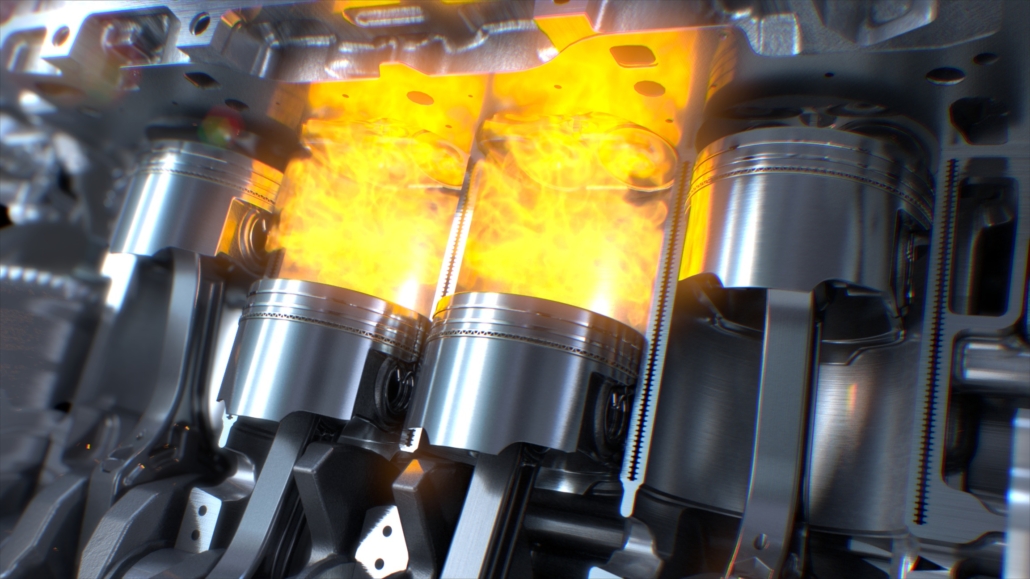
In actual fact, I think manufacturers have been able to increase the compression ratio during running for years, often inadvertently. The compression ratio is defined as the ratio of the the maximum cylinder volume (when the piston is at bottom dead center, BDC) to the minimum cylinder volume (when the piston is at top dead center, TDC). So if the volume of the combustion chamber at TDC is reduced, then the compression ratio is increased.
One way to reduce the volume at TDC is to increase the length of the connecting rod, which happens naturally on every engine, and which explains why I think everyone has been doing this for years. On Formula 1 engines that I have worked on, at maximum engine speed the rod stretches by around 0.2mm due to the inertial load from the piston, so there is an inherent increase in compression ratio, whether you want it or not.
There is talk by some that Mercedes and Red Bull are reaching 18.0:1, which would equate to a rod stretch of around 0.5mm. I wouldn’t be surprised to find out that they have cleverly designed the rod to expand in length due to a combination of the piston inertial load and thermal expansion. This would almost certainly be legal, as there is no regulation about the longitudinal stiffness or thermal expansion coefficient of the connecting rod.
Like I said though, these are just the ramblings of an ex-Formula 1 engine designer, with no factual evidence. But I’d love to hear your thoughts on this controversy. How do you think they’ve been able to raise the compression ratio during running? Is it even a controversy, if everyone has been doing it for years anyway? And is this just a distraction from other loopholes that we’re all missing?
 Jon Lesko, Infrared Detection & Analysis Systems
at 10000 rpm plus does the conrod actually have time to stretch 0.2mm? by the time its reacting to the load put on it surely its already gone up and down a dozen more times?
Yes, although it’s happening a few hundred times a second, the rod can stretch by this amount and more. We’ve seen evidence of this from the marks of the piston hitting the head when they wasn’t sufficient clearance.
3D printed ( powerbed ) pistion that can channel some of the combustion heat deeper into the center of the crown area and “grow” the crown and that way decrease the combustion chamber.